What Those Numbers Mean at the Dentist: Why Your Mouth Is Mapped 1 to 32
 By Robert Thorne
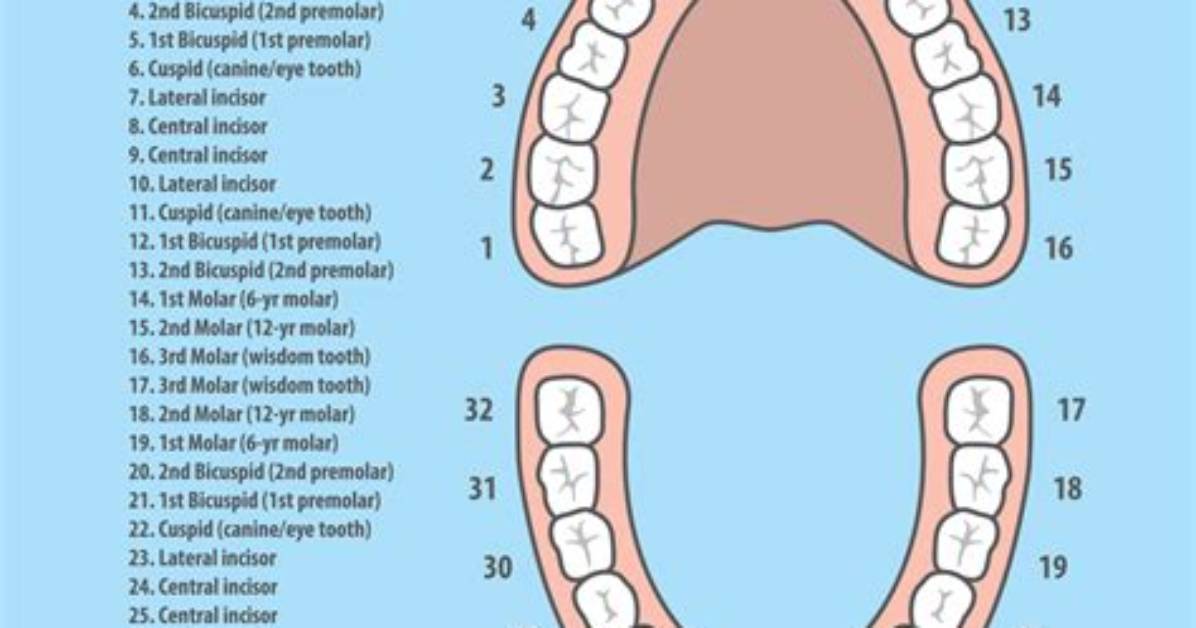
The 1-to-32 sequence holds absolute sway across the United States, but board a flight to Europe, Asia, or Australia, and dental charts shift to an entirely different standard. The FDI World Dental Federation two-digit system divides the mouth using dental quadrant mapping. Instead of a single continuous 32-digit loop, the upper right quadrant is designated as 1, upper left as 2, lower left as 3, and lower right as 4. Within each quadrant, teeth are numbered 1 through 8 starting from the central incisor outward.
Under the FDI system, tooth "11" is not an American premolar; it is Quadrant 1, Tooth 1 (the upper-right central incisor). Meanwhile, orthodontists often use Palmer notation, sketching a cross grid that isolates quadrants using right-angle brackets to map directional tooth movement visually.
| Tooth Name & Position | Universal Number (US) | FDI Two-Digit System (Global) | Clinical Function |
|---|---|---|---|
| Upper Right Central Incisor | #8 | 11 | Shearing, phonetics, smile line |
| Upper Left Canine | #11 | 23 | Tearing food, canine guidance |
| Lower Left First Molar | #19 | 36 | Primary chewing engine, vertical dimension |
| Lower Right Third Molar (Wisdom) | #32 | 48 | Vestigial grinding unit; frequently impacted |
Robert Thorne covers electric vehicle innovations, autonomous driving systems, global mobility trends, and automotive engineering developments.
