What Really Happens When a Spleen Bursts: the Silent Internal Emergency
 By Elena Rostova
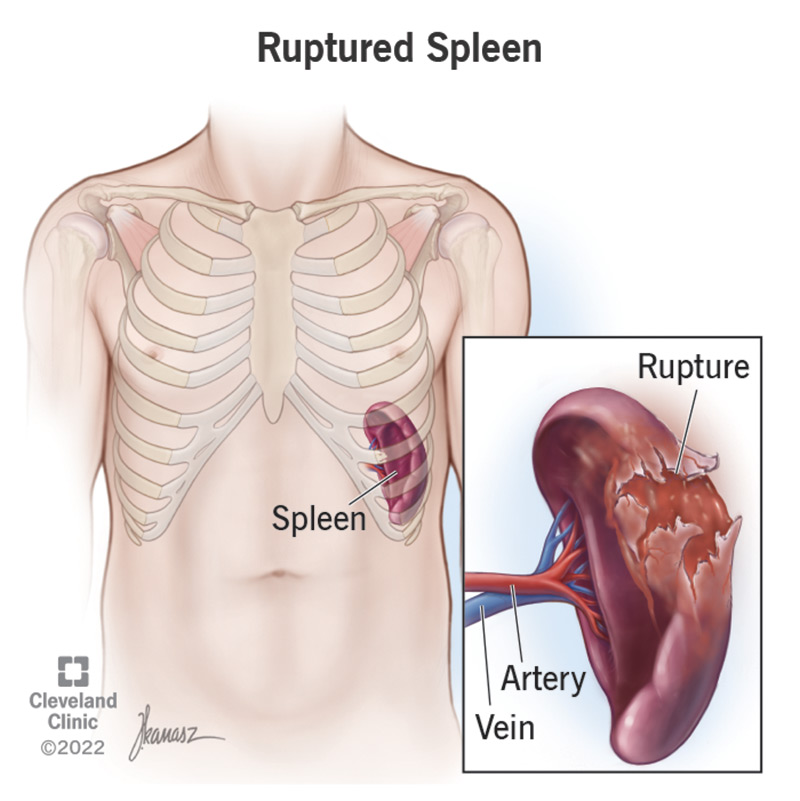
Can a ruptured spleen heal on its own without surgical intervention?
Yes. In hemodynamically stable patients with Grade I to Grade III lacerations, non-operative management succeeds in 85% to 90% of cases. Patients remain hospitalized under strict bed rest and continuous hemodynamic tracking while the laceration clots, granulates, and scars over over four to eight weeks.
What is a delayed splenic rupture, and when can it strike?
A delayed rupture occurs when an initial impact forms an intact subcapsular hematoma that does not immediately leak into the abdominal cavity. Over the course of 48 hours to two weeks, the hematoma breaks down osmotically, drawing in interstitial fluid, swelling, and eventually bursting through the capsule wall without warning.
How can clinicians tell the difference between standard abdominal bruising and a torn spleen?
While abdominal contusions cause superficial localized soreness that intensifies primarily with muscle movement, splenic lacerations provoke deep, rigid peritoneal guarding, Kehr’s sign (left shoulder tip pain), unexplained tachycardia, lightheadedness, and systemic shock that superficial bruising cannot produce.
Elena Rostova holds a Master's degree in Public Health Journalism. She covers groundbreaking medical research, holistic wellness trends, mental health awareness, and nutritional science.
