How to Write and Pronounce 'Good Morning' in Japanese: Kanji, Hiragana, and Audio Breakdown
 By Maya Lin-Takahashi
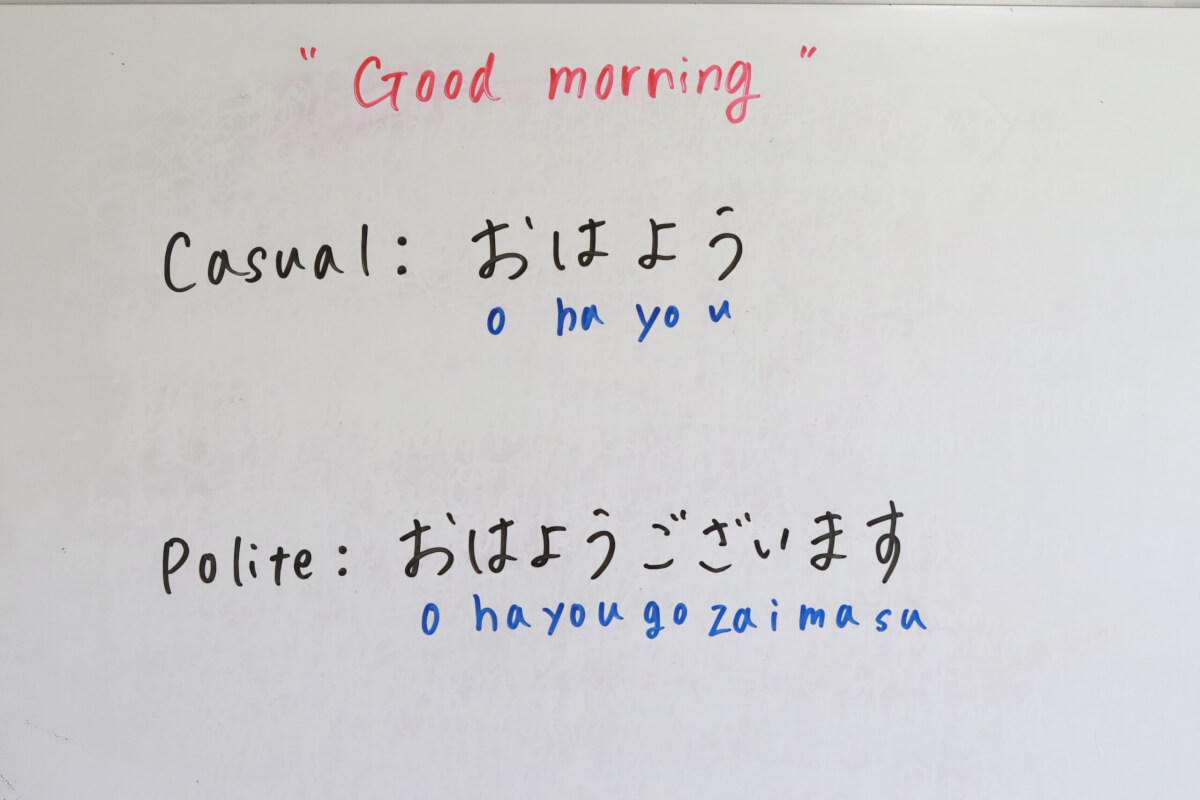
Japanese uses three interconnected scripts: hiragana, katakana, and kanji. When writing "good morning," learners confront two distinct orthographic forms: pure hiragana (おはようございます) and mixed kanji-hiragana (お早うございます).
In standard communication, public signage, digital correspondence, and casual notes, Japanese writers use pure hiragana. The nine characters form a fluid, phonetic chain:
お (o) + は (ha) + よ (yo) + う (u) + ご (go) + ざ (za) + い (i) + ま (ma) + す (su)
Writing this phrase by hand requires strict adherence to stroke order to maintain visual balance and character integrity:
1. お (o): Three strokes. Begin with a short horizontal stroke from left to right. Follow with a vertical stroke that drops down, loops sharply back up to the left, and wraps around into a wide, open lower curve. Finish with an accent dot on the upper right.
2. は (ha): Three strokes. Draw a left vertical line that slightly hooks upward at the base. Add a short horizontal stroke to the right, intersected by a downward stroke that loops at the bottom and exits horizontally to the right.
3. よ (yo): Two strokes. A short horizontal stroke at the top left, followed by a vertical downward stroke that loops to the left before extending out to the bottom right.
4. う (u): Two strokes. Place a small, tilted diagonal stroke at the top, then draw a large, curved downward arch beneath it.
5. ご (go): The character こ (ko) modified by two small diagonal diacritic marks (dakuten) at the top right, shifting the unvoiced "k" sound to a voiced "g."
6. ざ (za): The character さ (sa) modified with dakuten, shifting the "s" sound to "z."
7. い (i): Two strokes. A curved downward stroke on the left with a subtle inward flick at the base, mirrored by a shorter, straighter stroke on the right.
8. ま (ma): Three strokes. Two horizontal parallel strokes intersected by a vertical line that loops at the base and kicks out to the right.
9. す (su): Two strokes. A long horizontal stroke crossed by a central vertical stroke that forms a compact circular loop midway down before tapering straight down.
The kanji representation, お早うございます, incorporates the character 早 (read here as haya, meaning "early"). The top element of 早 represents the sun (日), hovering over a cross marker (十). Etymologically, the phrase stems from the adjective hayai (早い, early). Prefacing it with the honorific o- (お) and appending the polite auxiliary verb gozaimasu creates a literal translation approximating: "It is honorably early." While recognized across Japan, modern textbooks, marketing copy, and office chats favor the softer, faster-to-read hiragana script.
Maya is a hardware enthusiast who tests and reviews smart home devices, smartphones, wearables, and audio gear. She focuses on practical consumer value and build quality.
