Geometric Proof: Visualizing Perpendicular Slope Calculations on a Coordinate Grid
 By Sarah Jenkins
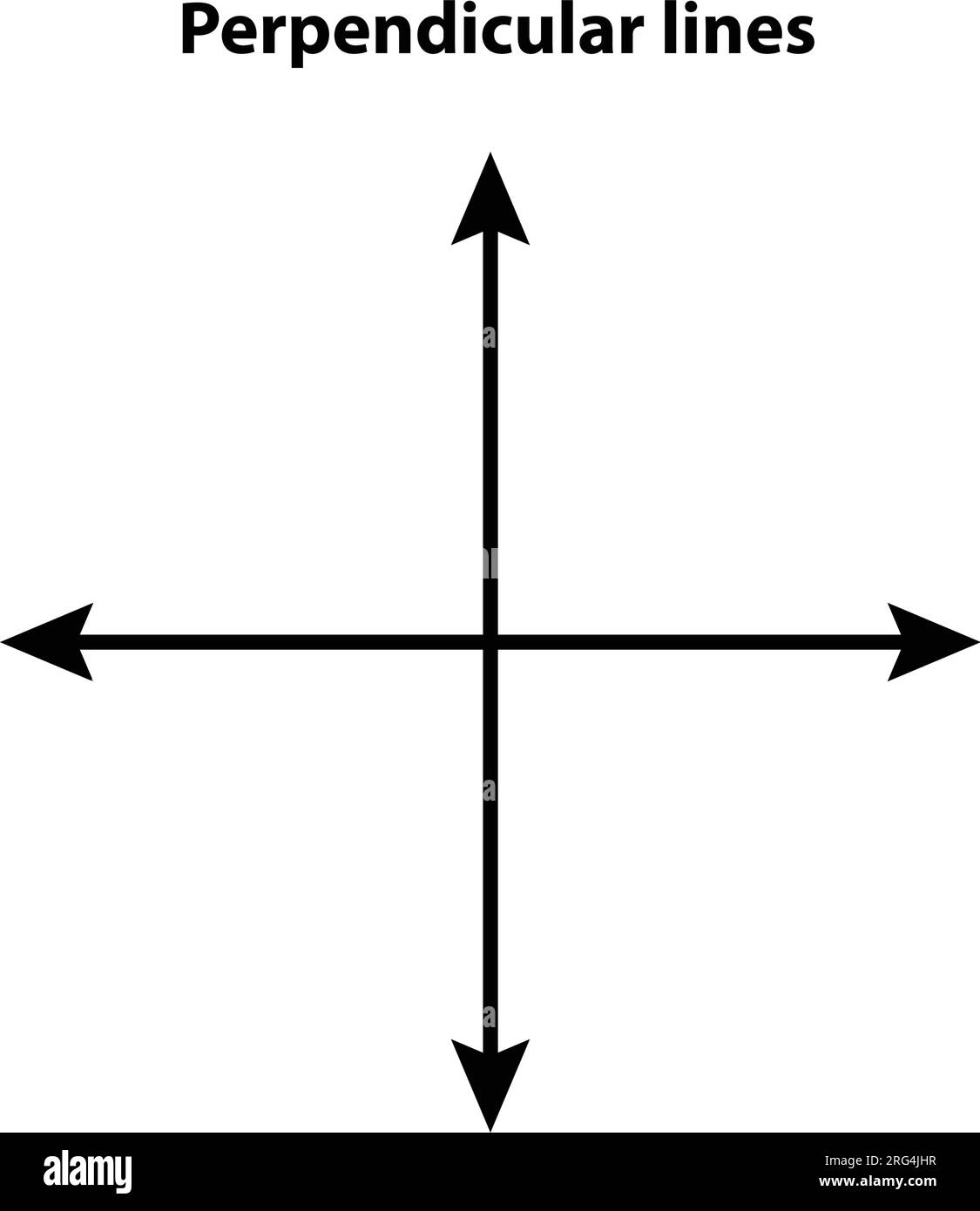
To put these mechanics into practice, let us solve a standard coordinate geometry problem: find the equation of a line perpendicular to $3x + 4y = 12$ that passes through the specific point $(6, -1)$.
Step 1: Extract the Original Slope
Convert the standard form linear equation into slope-intercept form ($y = mx + b$) by isolating $y$:
$$4y = -3x + 12$$
$$y = -\frac{3}{4}x + 3$$
The slope of the initial trajectory ($m_1$) is $-\frac{3}{4}$.
Step 2: Determine the Negative Reciprocal Slope
Apply the perpendicular condition $m1 \cdot m2 = -1$:
$$-\frac{3}{4} \cdot m_2 = -1$$
$$m_2 = \frac{-1}{-\frac{3}{4}} = \frac{4}{3}$$
The new slope is positive $4/3$.
Step 3: Apply Point-Slope Form
Use point-slope form with the known target coordinate $(x1, y1) = (6, -1)$:
$$y - y1 = m(x - x1)$$
$$y - (-1) = \frac{4}{3}(x - 6)$$
$$y + 1 = \frac{4}{3}x - 8$$
Step 4: Execute the y-Intercept Calculation
Subtract $1$ from both sides to finish the y-intercept calculation:
$$y = \frac{4}{3}x - 9$$
To express this result in standard form, multiply every term by $3$ to eliminate fractions:
$$3y = 4x - 27 \implies 4x - 3y = 27$$
Notice the coefficient relationship: the original line was $3x + 4y = 12$, and its orthogonal companion is $4x - 3y = 27$. The coefficients swapped positions, and the addition changed to subtraction.
Sarah Jenkins is a veteran tech journalist with over 12 years of experience covering artificial intelligence, mobile innovations, and digital ethics. Her insights have appeared in leading technology publications worldwide.
