From Triage to Active Labor: Tracking Contraction Waves Across Each Stage
 By Chloe Bennett
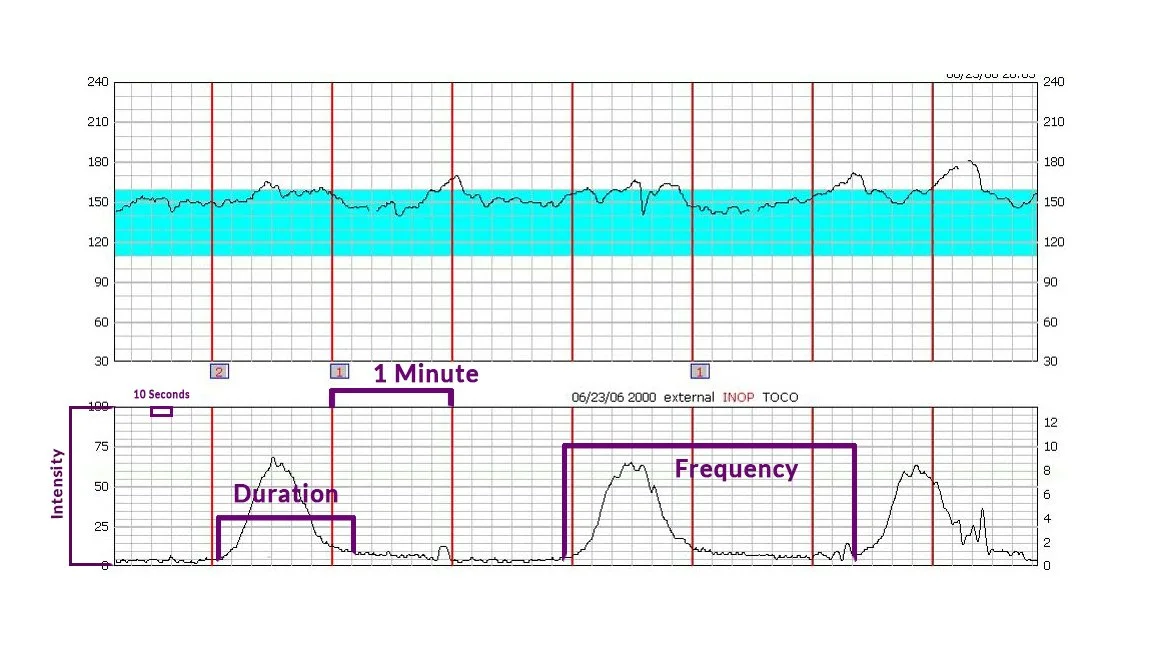
During external fetal monitoring, contractions are tracked by a round plastic puck called a tocodynamometer, strapped over the uterine fundus. The toco contains a pressure-sensitive mechanical button in its center. As the fundus contracts, it hardens and pushes the button inward, generating an electronic signal that charts an upward curve on the monitor.
The number displayed on the screen during external monitoring, often hovering around 10 to 20 at rest and climbing toward 60, 80, or 100 during a contraction, is widely misunderstood. That value is a relative measurement of abdominal wall deflection, not an absolute unit of physiological force. If the elastic belt is pulled tight, the baseline resting tone may display an artificial 25, sending the peak reading to 90. If the belt slips or the patient reclines, the exact same contraction might register at 40.
Because external tocodynamometer reading cannot quantify true contraction wave amplitude, nurses and obstetricians rely on digital palpation. Placing fingertips gently on the fundus at the peak of a wave provides the real measurement: a mild contraction feels soft like the tip of a nose, a moderate contraction resists pressure like a chin, and a strong active contraction feels unyielding, comparable to a forehead.
Chloe Bennett explores the intersection of pop culture, streaming entertainment, digital trends, and contemporary lifestyle. Her weekly commentary reaches thousands of culture enthusiasts.
